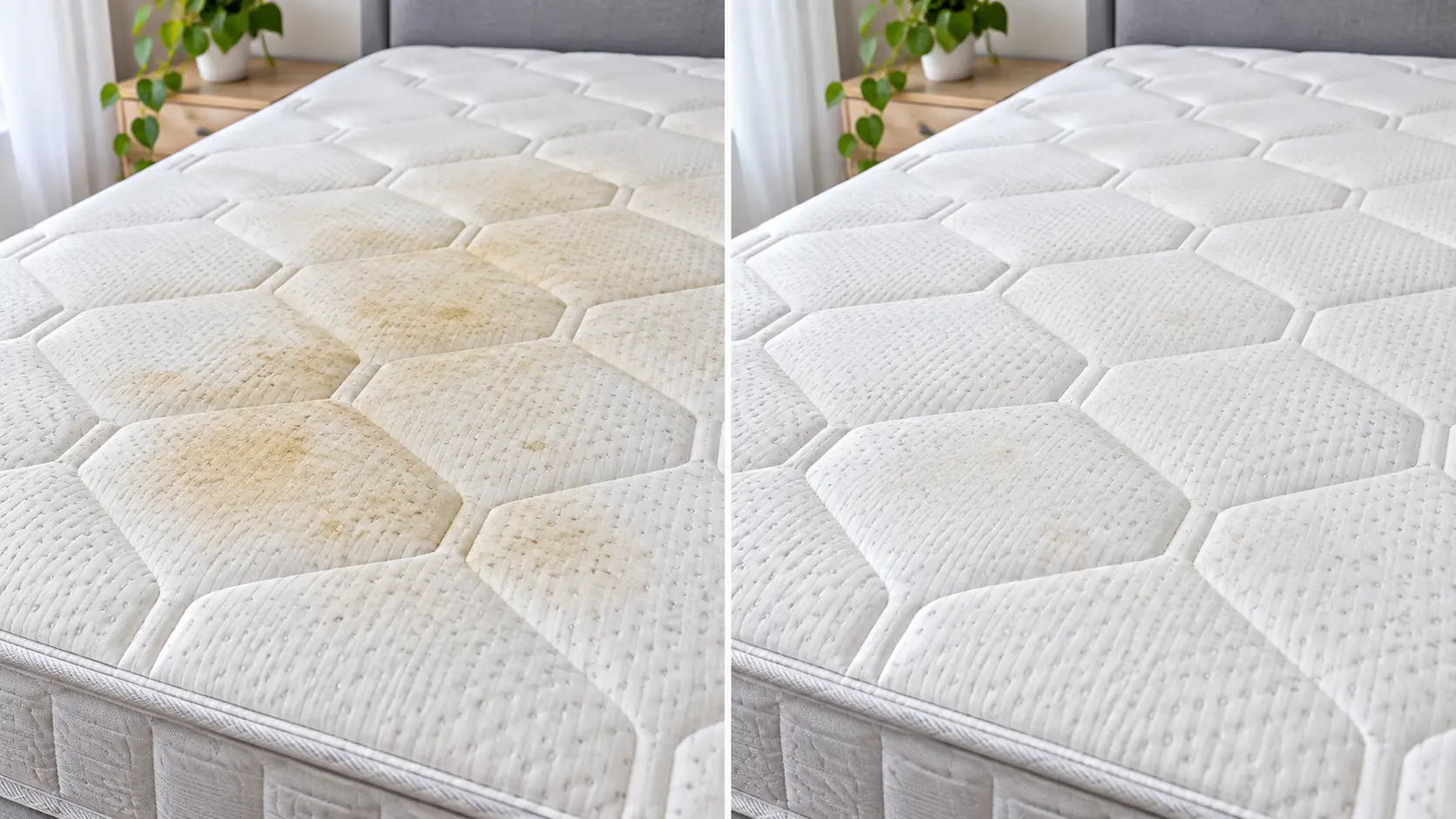
Mattress stains are almost universal. Sweat, body oils, accidental spills, a child's accident, a pet on the bed — over the years, a white or light-coloured mattress accumulates discolouration that regular bedsheet washing does nothing to address.
Not all stains respond to the same treatment. Using the wrong method doesn't just fail — it can set the stain permanently or damage the mattress fabric. This guide covers the most common mattress stain types, what actually works for each, the DIY approaches that make things worse, and when professional wet extraction is the only realistic solution.
Before treating any stain: Always blot fresh spills immediately — never rub, which spreads the stain and pushes it deeper into fibres. Use a clean white cloth or paper towels. Work from the outside of the stain inward to prevent spreading.
Sweat and body oil — yellow staining
The most universal mattress stain. Yellow or amber discolouration caused by years of sweat and body oil penetrating through the mattress protector and into the fabric. Usually covers large areas rather than distinct spots.
DIY — Fresh or mild staining
Mix equal parts hydrogen peroxide (3%), dish soap and baking soda into a paste. Apply to the stained area, allow to dry completely (several hours), then vacuum off. May lighten mild staining but rarely removes significant yellowing.
When you need professional cleaning
Significant yellow staining that covers large areas, or staining that's been there for more than a few months. Enzyme-based treatment followed by wet extraction can improve suitable organic staining; results vary by fabric and stain age. Expect significant improvement but not always complete removal of very old staining.
Urine stains
Common in households with young children or incontinent elderly residents, and in homes where pets sleep on the bed. Fresh urine is much easier to treat than dried or old stains.
DIY — Fresh urine (within 30 minutes)
Blot as much as possible immediately with paper towels. Apply white vinegar solution (equal parts white vinegar and water), blot again. Sprinkle baking soda over the area, allow to sit for several hours, then vacuum. The vinegar neutralises the ammonia in urine and reduces odour. This works reasonably well for a very fresh accident.
DIY — Enzymatic cleaners
Enzyme-based cleaners (available at pet shops and some hardware stores) break down the uric acid crystals in urine that cause persistent odour. These work better than vinegar for dried or older stains. Apply, allow full dwell time per product instructions, blot, allow to dry. Most effective when the stain is less than a week old.
When you need professional cleaning
Old urine stains that have dried and been there for weeks or months — the uric acid crystals have penetrated deep into the mattress fill, not just the surface fabric. DIY surface treatment addresses the surface only. Wet extraction reaches the deeper layers where odour is coming from. For pet urine particularly, which is more concentrated than human urine, professional extraction is almost always necessary for proper odour removal.
Blood stains
Blood is a protein stain — this determines the treatment approach entirely. The single most important rule: cold water only. Hot water denatures blood protein and sets the stain permanently.
DIY — Fresh blood
Cold water immediately — as much as possible. Blot, don't rub. Apply hydrogen peroxide (3%) directly to the stain — it will fizz as it reacts with the blood proteins. Blot again. Repeat until the stain is gone. For fabric care, rinse with cold water when done. Works well on fresh blood.
DIY — Dried blood
Make a paste of meat tenderiser (contains papain, a protein-digesting enzyme) and cold water. Apply, leave for 30–60 minutes, then blot and rinse with cold water. Also try a solution of liquid dish soap and cold hydrogen peroxide. Results vary significantly depending on how long the blood has been on the mattress.
When you need professional cleaning
Old blood stains that have been set for more than a few days, or large stain areas. Be honest with the professional team about what the stain is — it affects their pre-treatment choice. Some set blood stains are not fully removable by any method; a good company will tell you this upfront.
Mould spots
Dark spots — often black, green or grey — on the mattress surface or, more commonly, the underside. In Singapore's humidity, mattresses placed on low-platform beds or on the floor with poor air circulation are very susceptible to mould growth on the underside.
DIY — Surface mould on top
Mix one part white vinegar to one part water in a spray bottle. Spray the affected area lightly (don't soak — excess moisture worsens mould). Blot, then allow to dry completely in a well-ventilated area or in sunlight. Do NOT use bleach on a mattress — it damages fabric and is too harsh for sleeping surfaces. Effectiveness is limited — DIY addresses surface spores but not embedded mould in the fill.
When you need professional cleaning — or replacement
Any significant mould growth, or mould on the underside of the mattress. Mould that has penetrated below the surface fabric into the fill or springs is very difficult to properly remediate. Professional cleaning with appropriate anti-microbial treatment addresses surface and near-surface mould. If mould has penetrated deeply or covers a large area, the honest recommendation is replacement — heavily mould-affected mattresses can cause ongoing respiratory issues regardless of surface treatment.
Food and drink spills
Coffee, tea, juice, wine — the treatment approach depends on whether the spill is fresh or dried.
DIY — Fresh spills
Blot immediately and thoroughly. For coloured drinks (coffee, juice, wine): cold water first to dilute, then a solution of liquid dish soap and cold water. Blot, don't rub. Work from the outside in. For oily spills: sprinkle baking soda or cornstarch to absorb the oil before applying any liquid treatment.
DIY — Dried stains
Hydrogen peroxide (3%) works on most dried food and drink stains. Apply, allow a few minutes to work, blot. For coffee or tea: a diluted white vinegar solution can help lift the tannin-based staining. Results depend significantly on how long the stain has been there.
When you need professional cleaning
Large spill areas, stains that have been there more than a few weeks, or spills that have soaked deeply into the mattress. If the mattress has a smell from an old spill — that means the liquid reached the fill material, which surface treatment won't address.
What NOT to do — DIY mistakes that permanently worsen stains
- Never use hot water on blood stains — protein stains set permanently with heat.
- Never rub stains — always blot. Rubbing spreads the stain and pushes it deeper.
- Never soak the mattress — mattresses don't dry evenly and excess moisture causes mould growth in the fill. Use damp treatment, not wet.
- Never use bleach on a mattress — damages fabric, harmful fumes, not appropriate for sleeping surfaces.
- Never use a steam cleaner without proper extraction — steam without immediate extraction pushes moisture deeper into the mattress, potentially causing mould.
- Don't apply heat to dry a freshly treated stain — hair dryers and heat guns can set stains. Air dry only, with a fan to assist.
The honest assessment: Many DIY stain treatments reduce visibility rather than fully removing stains. For an old mattress with significant staining across multiple areas, professional wet extraction — which reaches the deeper fibres and uses commercial pre-treatment solutions matched to specific stain types — produces meaningfully better results than surface DIY treatment.
Book a professional mattress clean
WhatsApp us your mattress size and stain situation for an honest assessment. Fixed price, reply during working hours.
Get My Free Quote